Sir John Lavery, RA, RSA, RHA
(1856 - 1941)
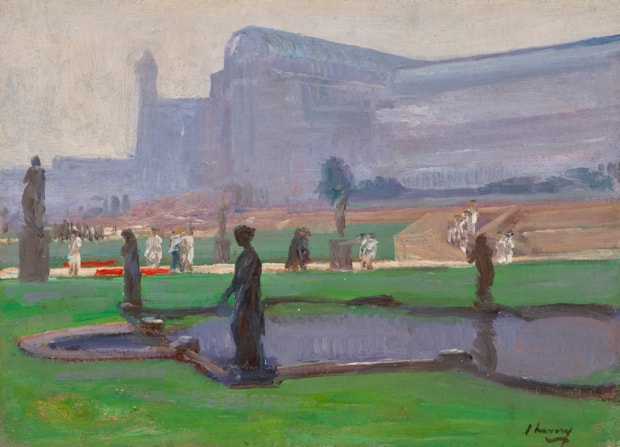
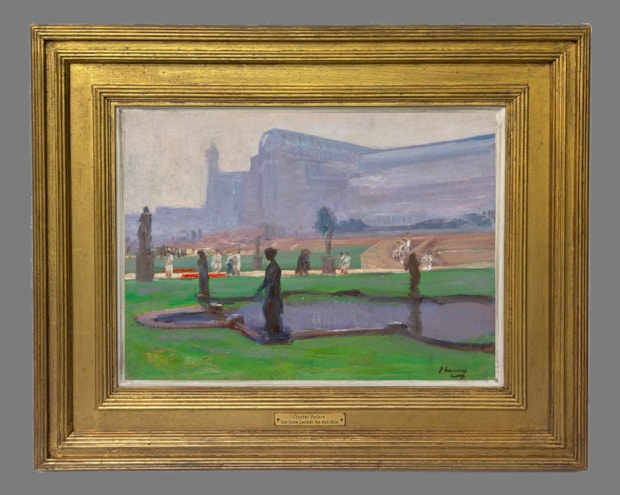
Crystal Palace, 1916
Signed, lower right: J Lavery; further signed and titled, on the reverse
Oil on canvas laid on board
9¾ x 13¾ in - 25 x 35.5 cm
Oil on canvas laid on board
9¾ x 13¾ in - 25 x 35.5 cm
Tel.: +44 (0)20 7839 7693
Provenance
The artist;
The Hon. Mrs. A. Holt (artist's granddaughter);
By descent;
Private collection, UK
Following the outbreak of the First World War, the celebrated society painter Sir John Lavery sought to enlist with the Artists’ Rifles but was deemed too old for active service. Instead, he turned his attention to recording aspects of the war at home, before a serious car accident in London during the summer of 1915 forced a prolonged period of convalescence. By the following year, Lavery had resumed painting and began observing the Royal Naval Division at the recently requisitioned Crystal Palace, Sydenham, which had been converted into a major naval training and accommodation centre. These observations resulted in two important works now in the collection of the Imperial War Museum: 'Royal Naval Division, Crystal Palace: The Spot Known as the Quarter-Deck' (1916) and 'Royal Naval Volunteer Reserve, Crystal Palace' (1917).
The present work, almost certainly painted en plein air, is likely one of a number of studies executed during this period as Lavery familiarised himself with the setting and developed ideas for larger compositions. Sailors in white naval uniform are dispersed across the grounds before the unmistakable silhouette of the Crystal Palace, its vast glass and iron structure rendered in muted tones of grey and mauve. The artist’s fluent brushwork and restrained palette lend the scene an immediacy and spontaneity characteristic of his finest oil sketches.
Lavery was knighted in 1918 in recognition of his services to art and his contribution as an official war artist during the First World War.
The work was formerly in the collection of the Hon. Mrs Holt, the artist’s granddaughter, and has descended through the family.
The Hon. Mrs. A. Holt (artist's granddaughter);
By descent;
Private collection, UK
Following the outbreak of the First World War, the celebrated society painter Sir John Lavery sought to enlist with the Artists’ Rifles but was deemed too old for active service. Instead, he turned his attention to recording aspects of the war at home, before a serious car accident in London during the summer of 1915 forced a prolonged period of convalescence. By the following year, Lavery had resumed painting and began observing the Royal Naval Division at the recently requisitioned Crystal Palace, Sydenham, which had been converted into a major naval training and accommodation centre. These observations resulted in two important works now in the collection of the Imperial War Museum: 'Royal Naval Division, Crystal Palace: The Spot Known as the Quarter-Deck' (1916) and 'Royal Naval Volunteer Reserve, Crystal Palace' (1917).
The present work, almost certainly painted en plein air, is likely one of a number of studies executed during this period as Lavery familiarised himself with the setting and developed ideas for larger compositions. Sailors in white naval uniform are dispersed across the grounds before the unmistakable silhouette of the Crystal Palace, its vast glass and iron structure rendered in muted tones of grey and mauve. The artist’s fluent brushwork and restrained palette lend the scene an immediacy and spontaneity characteristic of his finest oil sketches.
Lavery was knighted in 1918 in recognition of his services to art and his contribution as an official war artist during the First World War.
The work was formerly in the collection of the Hon. Mrs Holt, the artist’s granddaughter, and has descended through the family.


Biography
This well-known figure of the Royal Academy was a founder member of the New English Art
Club (1886). This was considered a more important date in the history of British painting
than even the founding of the Pre-Raphaelite Brotherhood.
The New English Art Club set out without any pedantic formula and revolutionised think in
the sense that it stood for freedom of expression.
The first exhibitions included artists of such varied talent as Mark Fisher (1841-1923), Lavery,
Sir James Jebusa Shannon, RA, RBA, RHA (1862-1923), Philip Wilson Steer, OM (1860-1942)
and Henry Scott Tuke, RA, RWS (1858-1929). As a group they were fully aware of the
importance of the French Impressionist School and the early intention was to limit
membership to artists who had studied in France.
The landscape in the painting of Newmarket is English and so is the weather, but one feels
that it has the influence of the French painters. A painting of “The Jockeys’ Dressing Room at
Ascot” hangs in London, Tate Britain. The Tate also possesses such varied works as “The Golf
Course”, “North Berwick” and “The Chess Players”. In 1886 a fine painting entitled “The Tennis
Match” was exhibited at the Royal Academy.
His works can be found in museums in: Berlin; Birmingham; Bradford; Brussels; Dublin;
Edinburgh; Glasgow; London, Tate Gallery and Munich.

YOU MAY ALSO LIKE