Henry Pether
(1800 - 1880)
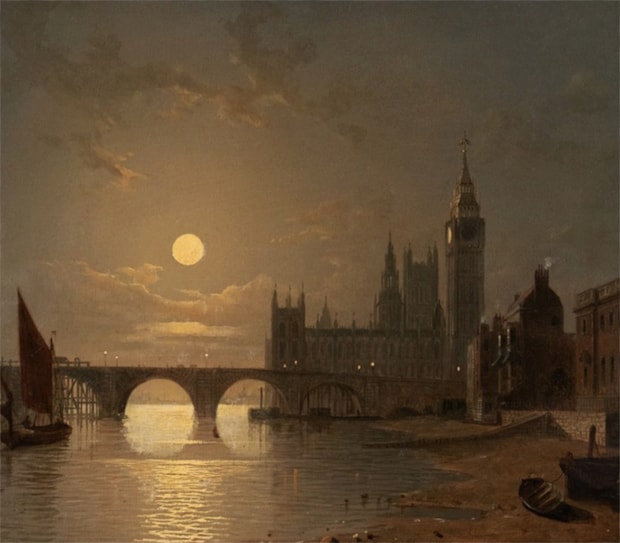
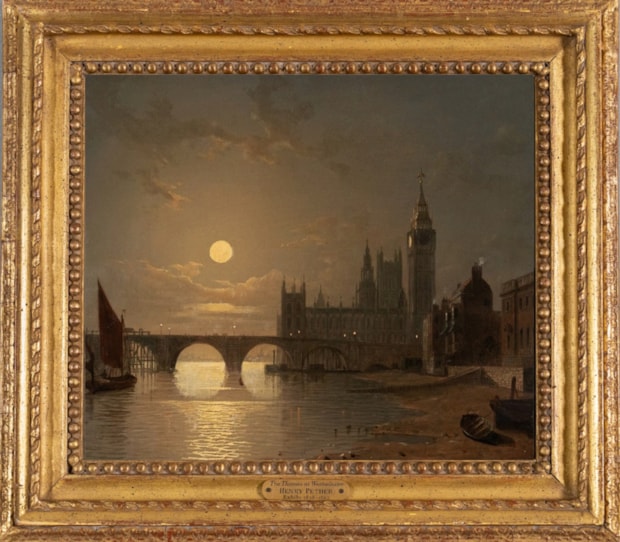
Westminster
Signed, lower right:
Oil on panel
10 x 11½ in - 25.4 x 29.2 cm
Frame size
13⅛ x 14¾ in - 33.3 x 37.5 cm
Tel.: +44 (0)20 7839 7693
Provenance
Private collection, UK


Biography
Henry Pether was the son of landscape painter Abraham Pether (1752-1812) and younger
brother of artist Sebastian Pether (1793-1844). Like his father, Henry was renowned in
particular for his moonlit landscapes and city scenes. Working in the second and third quarters
of the 19th century having studied with his father Henry was perhaps the most successful
member of the family.
Henry Pether is recorded as living in Surrey Square in London in 1826 before moving to Park
Street, Camden in 1834 and south of the Thames to Clapham some three years later. He
travelled widely through the United Kingdom, painting on the Medway in Kent, Southampton,
Chichester, Plymouth and visiting the renowned and picturesque Tintern Abbey in the Wye
Valley. The ‘picturesque’ was in vogue in the mid-19th century and Tintern was much visited.
Pether also painted in Scotland, again a draw for many artists following the popularisation of
Scotland and the romance of the Highlands by Queen Victoria.
However, it was for his town and city scenes by moonlight that Henry Pether was renowned,
particularly views in London and on the Thames.
He exhibited from 1828-1862 at the Royal Academy, the British Institution and Suffolk Street.
Late in his career he visited Italy, as had his father, and painted in Rome and produced a
number of Venetian views by night.
His works can be found in museums in: Hastings Museum; London, National Maritime
Museum, Tate Gallery; Southampton, the Government Art Collection possess 9 works;
Connecticut, Yale Center for British Art and Australia, National Gallery of Victoria.

YOU MAY ALSO LIKE