


Alexander Calder
(1898 - 1976)
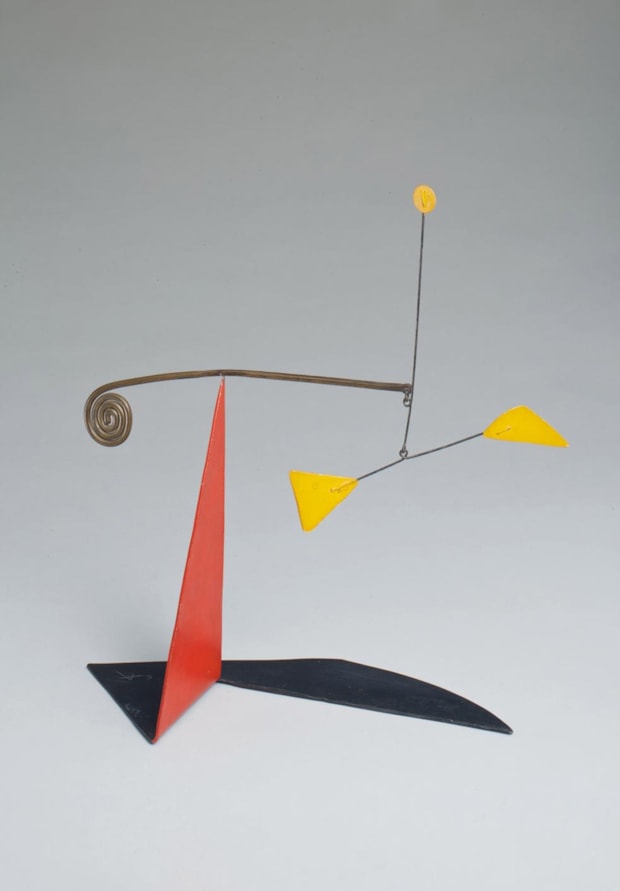
3 Yellow and Spiral on Red and Black
Signed with artist's monogram 'CA' on the base
Standing Mobile - painted sheet metal, wire and brass rod
12¼ x 12¼ x 10 in
31.1 x 31.1 x 25.4 cm
Executed in 1960
Standing Mobile - painted sheet metal, wire and brass rod
12¼ x 12¼ x 10 in
31.1 x 31.1 x 25.4 cm
Executed in 1960
Tel.: +44 (0)20 7839 7693
Provenance
Mr and Mrs Frank and Sarah Jane Lichtenstein, San Antonio, Texas;
By descent;
Private Collection, Texas, USA;
MacConnal-Mason Gallery (2012);
Private collection, UK.
By descent;
Private Collection, Texas, USA;
MacConnal-Mason Gallery (2012);
Private collection, UK.
Biography
Alexander Calder was born into an artistic family; both his father and grandfather (of the same
name) were successful sculptors. His father had created many public sculptures, most of
which were in Philadelphia. His grandfather, a Scottish immigrant who came to Philadelphia
in 1868 is best known for his monumental statue of William Penn (1644-1718), (founder of
the province of Pennsylvania) on top of the Philadelphia town hall tower. Calder’s mother,
Nanette, was a professional portrait painter who had studied at the Académie Julian in Paris,
(1888-1893). Nanette met Alexander at the Pennsylvania Academy of Fine Arts whilst she was
studying there.
Calder was educated at Croton-on-Hudson High School in New York State after which he
attended Yonkers High. His father was appointed acting chief of the Department of Sculpture
at the Panama Pacific International Exposition in San Francisco. Calder moved to San
Francisco where he completed his studies and graduated from Lowell High School in 1915.
Following training at Plattsburg Civilian Military Training Camp he joined the naval section of
the Student’s Army Training Corps. Calder went on to study mechanical engineering at
Stevens Institute of Technology in Hoboken, New Jersey, where he also excelled in
mathematics. He completed his degree at Stevens in 1919 and for the next few years worked
in several engineering jobs; a hydraulics engineer and draughtsman for the New York Edison
Company, followed by work as a mechanic for the H. F. Alexander passenger ship. Upon
completion of the ship, Calder took employment as a timekeeper in a logging camp, where the
surrounding mountainous landscape inspired him to make some paintings. Thereafter, he set
upon his artistic career and moved back to New York.
Calder enrolled with the Art Students League in New York whilst working part time for the
National Police Gazette. It was during an assignment for the Gazette in which Calder was
asked to make sketches of the Ringling Brothers and Barnum and Bailey Circus that the artist’s
fascination with the Circus began, a subject that he would come back to periodically
throughout his career.
In 1926 Calder moved to Paris and established a studio there. He befriended many of the
artistic elite, including Jean Arp (1886-1966), Joan Miró (1893-1983) and Marcel Duchamp
(1887-1968). He held his first solo show of wire sculpture in Paris at Galerie Billiet in 1929.
It was not long before he started to develop his kinetic sculptures, or ‘mobiles’, which first
appeared circa 1932. Not only did he start to create sculptures that took their motion from
natural air currents, but also made the first hanging sculptures with movable elements. Many
of these early works were reminiscent of natural forms such as leaves, fish and birds.
Calder returned to the US in 1933, where he set up a home in Connecticut with his wife
Louisa, whom he had first met on a boat to Paris. Here they raised their two children Sandra
and Mary. In 1962 Calder settled into a new workshop in Indre-et-Loire, France. He made
many mobiles and gouache paintings, some of which he gifted to his friends and neighbours.
He even donated a large sculpture to the town, which since 1974 has been situated in front of
the church there. In 1966 his Autobiography with Pictures was published. He died on 11th
November 1976, following the opening of a major retrospective at the Whitney Museum in
New York.
His work can be found in prestigious private and public collections throughout the World
including: Madrid, Museo Nacional Centro de Arte Reina Sofía; Paris, Centre Georges
Pompidou; New York, The Whitney Museum of American Art, Museum of Modern Art and
Washington DC, National Gallery of Art.
