


Armand Guillaumin
(1841 - 1927)
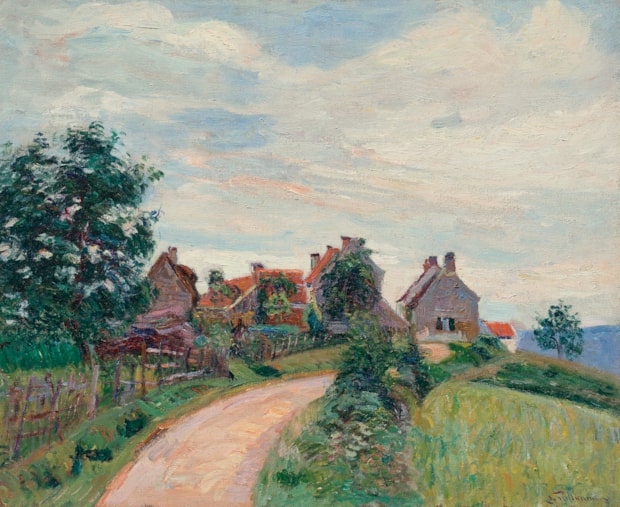
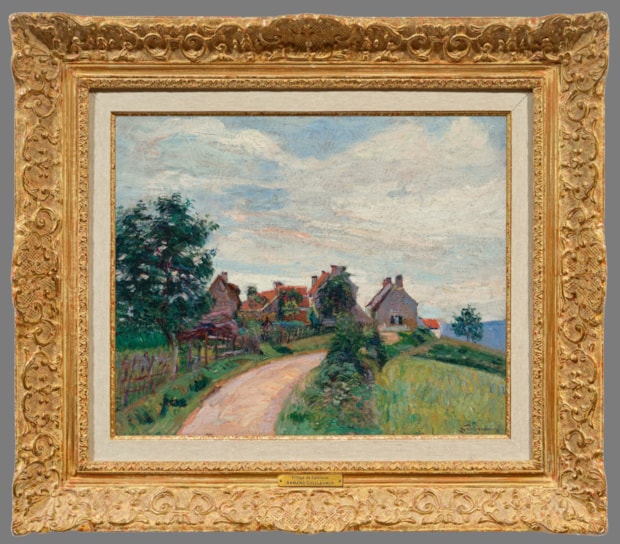
Village de Damiette
Signed, lower right: Guillaumin
Oil on canvas
14¾ x 18 in – 37.5 x 45.9 cm
Frame size
25⅞ x 22⅝ in - 65.7 x 57.5 cm
Oil on canvas
14¾ x 18 in – 37.5 x 45.9 cm
Frame size
25⅞ x 22⅝ in - 65.7 x 57.5 cm
Tel.: +44 (0)20 7839 7693
Provenance
Galerie Pierre Levy, Paris (label on verso);
Private collection, Switzerland, 12 December 2007;
Private collection, France
Private collection, Switzerland, 12 December 2007;
Private collection, France
 Exhibition
Chatou 2003, Armand Guillaumin, L’Impressionniste fauve, Musée Fournaise,
26 April – 2 November 2003, no.24 (label on verso)
26 April – 2 November 2003, no.24 (label on verso)


Biography
In an article titled Naturalism at the Salon of 1880, Emile Zola wrote “the true revolutionaries of the form appear with Monsieur Edouard Manet with the Impressionists Claude Monet, Renoir, Pissarro, Guillaumin and others too…”
Born in Paris in 1841, Armand Guillaumin worked in his uncle’s shop in his youth while attending evening drawing classes. After a period on the railways, he enrolled at the Académie Suisse in 1861, where he formed close friendships with Camille Pissarro (1830–1903) and Paul Cézanne (1839–1906). Together, they exhibited at the Salon des Refusés in 1863, placing Guillaumin at the heart of the avant-garde circle challenging the conventions of French painting. In 1872, Pissarro introduced him to Dr Paul Gachet, an important early patron of the Impressionists. Gachet invited Guillaumin to paint alongside Cézanne at his house in Auvers-sur-Oise and acquired several of his works, including Sunset at Ivry, now in the Musée d’Orsay.
Guillaumin exhibited at the first Impressionist exhibition in 1874 and participated in five subsequent exhibitions. His early subjects were drawn largely from the landscapes surrounding Paris: the Seine and its bridges and barges, industrial districts and riverbanks. In works such as The Bridge of Louis Philippe (1875), now in the National Gallery of Art, Washington, he combined the Impressionist interest in transient light and atmosphere with a strong architectural sense of composition.
His connections with the younger generation of artists continued into the 1880s. In 1887, he became acquainted with Vincent and Theo van Gogh. Theo subsequently sold Guillaumin’s Landscape, Riverbanks, while the brothers acquired two of his portraits for their collection.
By the middle of the 1880s, Guillaumin’s painting was moving towards a more vibrant and expressive use of colour, accompanied by increasingly broad and emphatic brushwork. This development became particularly pronounced towards the end of the decade, following his discovery of the Creuse region in 1887. The dramatic landscapes around Crozant, in the Limousin, became an important and recurring source of inspiration, allowing his vigorous handling of colour and paint to fully develop.
It was above all in landscape that Guillaumin found his distinctive voice. Whether depicting the waterways and bridges of Île-de-France or the rugged valleys of the Limousin, he brought together keen observation of nature with a bold and increasingly expressive use of colour.
Guillaumin continued to paint and exhibit throughout his long career, remaining steadfast in his commitment to landscape. He died in Paris on 26 June 1927.
His works can be found in museums in: Aberdeen; London; Paris; Amsterdam; St. Petersburg Hermitage; Boston; Cleveland; Oklahoma (Fred Jones Jr. Museum of Art - University of Oklahoma) and Washington.

YOU MAY ALSO LIKE


