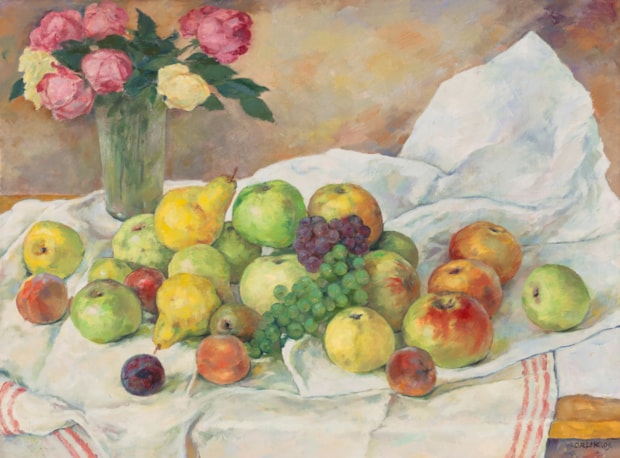
Emil Orlik
(1870 - 1932)
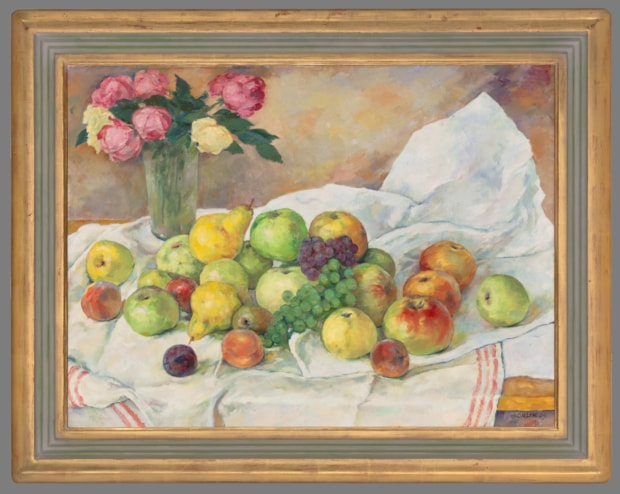
Fruit and roses on a table
Signed and dated, lower right: ORLIK 09;
titled and signed, on the reverse: E. ORLIK BERLIN SW11
Oil on canvas
23⅝ x 31½ in – 60 x 80 cm
titled and signed, on the reverse: E. ORLIK BERLIN SW11
Oil on canvas
23⅝ x 31½ in – 60 x 80 cm
Tel.: +44 (0)20 7839 7693
Provenance
Sale, Villa Grisebach, Berlin, 25 November 1995, lot 146;
Private collection, Vienna
Private collection, Vienna
 Exhibition
Eugen Otto (ed.), Emil Orlik, Leben und Werk, 1870-1932, Prag-Wien-Berlin, Vienna, 1997, p.124, illus.


Biography
Emil Orlik was among the most versatile and internationally respected artists of the late 19th and early 20th centuries. Born in Prague, then part of the Austro-Hungarian Empire, the son of a tailor, he rose to prominence as a painter, printmaker, illustrator and designer, earning recognition across Europe and beyond.
Orlik’s artistic training began at Heinrich Knirr’s private art school in Munich continuing at the Munich Academy in 1891, where he studied under Wilhelm Lindenschmidt (1829-1895). He later studied printmaking under Johann Leonhard Raab (1825-1899), which laid the foundations for his later experimentation with etching, lithography, and woodcut.
Following military service in 1984, Orlik settled in Munich where he contributed illustrations to the influential journals Jugend (Youth) and PAN. His reputation as a printmaker grew rapidly, and by 1897 Max Lehrs, assistant director of the Kupferstichkabinett (Prints and Drawings Collection) in Dresden, had begun acquiring his works for the museum’s distinguished print collection.
After travelling extensively throughout Europe and making many contacts, among them Felix Vallaton in Paris and William Nicholson in London, Orlik moved to Vienna where he joined the Vienna Secession. Within this influential circle, he quickly established himself as a distinguished portraitist and graphic artist.
His first solo exhibition, held in Austria in 1900, was met with considerable acclaim. Further solo exhibitions followed in 1902, including in Prague where the entire exhibition was bought by the Kupferstichkabinett in Dresden, firmly establishing his reputation. That same year, Orlik embarked on his first journey to Japan to study traditional Japanese art and woodblock-printing techniques firsthand, which would prove a lifelong source of inspiration.
In 1905 Orlik moved to Berlin, where he was appointed professor at the School of the Museum of Decorative Arts, now part of the Berlin State Museums. He remained there until his retirement in 1930. Alongside his teaching, he continued to travel widely, visiting North Africa, China, Korea, Japan, Siberia, and later the United States. These journeys profoundly enriched his work and secured his reputation as a central figure in the artistic exchange between Europe and East Asia.
By the final decades of his life, Orlik was recognised as one of the leading graphic artists of his generation. He remained active as a painter, printmaker, illustrator, and teacher until his death in Berlin in 1932.
His works can be found in museums and public collections throughout Europe, Japan and the United States including Rijksmuseum (Amsterdam), The Fitzwilliam Museum (Cambridge), Victoria & Albert Museum and The British Museum (London), National Gallery (Prague), National Museum of Western Art (Taito, Japan) and Metropolitan Museum and Museum of Modern Art (New York)
Orlik’s artistic training began at Heinrich Knirr’s private art school in Munich continuing at the Munich Academy in 1891, where he studied under Wilhelm Lindenschmidt (1829-1895). He later studied printmaking under Johann Leonhard Raab (1825-1899), which laid the foundations for his later experimentation with etching, lithography, and woodcut.
Following military service in 1984, Orlik settled in Munich where he contributed illustrations to the influential journals Jugend (Youth) and PAN. His reputation as a printmaker grew rapidly, and by 1897 Max Lehrs, assistant director of the Kupferstichkabinett (Prints and Drawings Collection) in Dresden, had begun acquiring his works for the museum’s distinguished print collection.
After travelling extensively throughout Europe and making many contacts, among them Felix Vallaton in Paris and William Nicholson in London, Orlik moved to Vienna where he joined the Vienna Secession. Within this influential circle, he quickly established himself as a distinguished portraitist and graphic artist.
His first solo exhibition, held in Austria in 1900, was met with considerable acclaim. Further solo exhibitions followed in 1902, including in Prague where the entire exhibition was bought by the Kupferstichkabinett in Dresden, firmly establishing his reputation. That same year, Orlik embarked on his first journey to Japan to study traditional Japanese art and woodblock-printing techniques firsthand, which would prove a lifelong source of inspiration.
In 1905 Orlik moved to Berlin, where he was appointed professor at the School of the Museum of Decorative Arts, now part of the Berlin State Museums. He remained there until his retirement in 1930. Alongside his teaching, he continued to travel widely, visiting North Africa, China, Korea, Japan, Siberia, and later the United States. These journeys profoundly enriched his work and secured his reputation as a central figure in the artistic exchange between Europe and East Asia.
By the final decades of his life, Orlik was recognised as one of the leading graphic artists of his generation. He remained active as a painter, printmaker, illustrator, and teacher until his death in Berlin in 1932.
His works can be found in museums and public collections throughout Europe, Japan and the United States including Rijksmuseum (Amsterdam), The Fitzwilliam Museum (Cambridge), Victoria & Albert Museum and The British Museum (London), National Gallery (Prague), National Museum of Western Art (Taito, Japan) and Metropolitan Museum and Museum of Modern Art (New York)

YOU MAY ALSO LIKE