


Julia Beck
(1853 - 1935)
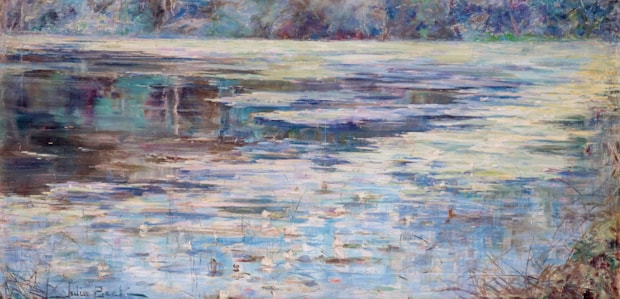
L’Etang Saint-Cucufa, près Vaucresson
Signed
Oil on canvas
19⅔ x 39⅓ in - 50 x 100 cm
Oil on canvas
19⅔ x 39⅓ in - 50 x 100 cm
Tel.: +44 (0)20 7839 7693
Provenance
Private collection, France;
with MacConnal-Mason Gallery (2015);
Private collection, UK
with MacConnal-Mason Gallery (2015);
Private collection, UK
 Literature
P. Sanchez, Dictionnaire de L'union des femmes peintres et sculpteurs, Vol.I, 2010, p.160, under 1905, No.70;
F. Claustrat, Julia Beck, dans l'air du temps, in Connaissance des arts, 18 August 2012;
Kåa Wennberg, Brev från Julia Beck, 2013, illustrated in colour (detail) p.3 as well as full spread in colour pp.76-77
F. Claustrat, Julia Beck, dans l'air du temps, in Connaissance des arts, 18 August 2012;
Kåa Wennberg, Brev från Julia Beck, 2013, illustrated in colour (detail) p.3 as well as full spread in colour pp.76-77
Exhibition
Paris, Grand Palais, 24ème Exposition Annuelle, 12 February – 9 March 1905, No.70;
Sweden, Mora, Zornmuseet, Julia Beck, 15 June – 14 September 2012;
Stockholm, Sven-Harrys (Konstmuseum), Julia Beck, 25 May – 1 September 2013
Sweden, Mora, Zornmuseet, Julia Beck, 15 June – 14 September 2012;
Stockholm, Sven-Harrys (Konstmuseum), Julia Beck, 25 May – 1 September 2013
Biography
Julia Beck was born in Stockholm on the 20th December 1853, her father, Franz Beck being a bookbinder.
She studied at the Academy of Art in Stockholm 1872-1878 where she was one of a group of women artists several of whom were to have flourishing careers and that at a time when life as a female artist was not an easy choice of career.
Following the Academy in Stockholm, Beck moved to Paris where in Montparnasse she shared a studio with fellow Scandinavian painters Harriett Bach, Anna Munthe-Norstedt (1854-1936) and Hildegard Thorell (1850-1930), before moving to Grez-sur-Loing in 1882. Grez, south of Fontainebleau was a thriving artistic colony settled by a number of Scandinavian artists including members of the Skagen Group. Carl Larsson (1853-1919) and his wife Karin Bergöö (1859-1928) a friend of Julia Beck’s, August Strindberg (1849-1912) and the American artists John Singer Sargent (1856-1925), Willard Metcalf (1858-1925) and Theodore Robinson (1852-1896), amongst others. Frederick Delius (1862-1934) and Robert Louis Stevenson (1850-1894) were also members of this artistic colony; the bridge, a landmark of Grez-sur-Loing, appears in numerous paintings.
Grez was a wonderful source of inspiration to Julia Beck, primarily a landscape painter who also turned her hand to portraits. She exhibited at the Paris Salon from 1880 and remained living in France throughout her life, moving to Vaucresson in 1888 although returning to Sweden occasionally and remained in contact with fellow artist Jenny Nyström (1854-1946), Eva Bonnier (1857-1909) and Karin Bergöö. Beck drew on the landscape around Vaucresson, her most important composition being Nenuphar’s or Water Lilies on l’Etang Saint Cucufa, near her home in Vaucresson, a subject which was to become synonymous with Claude Monet at Givenchy some 65 kilometres away.
Beck travelled extensively in Normandy, painting in Honfleur, Flamanville, Val-Saint-Martin and Rouen, and to Paris, a short distance from her home in Vaucresson.
Beck was a highly successful female artist, a Scandinavian Impressionist though she spent the majority of her working life in France. Her contribution was recognised by the French State in 1934 with the award of the Legion of Honour.
Julia Beck died in Versailles in 1935.
Her works can be found in museums in: Mora, Zorn Museum and Stockholm, National Museum.
She studied at the Academy of Art in Stockholm 1872-1878 where she was one of a group of women artists several of whom were to have flourishing careers and that at a time when life as a female artist was not an easy choice of career.
Following the Academy in Stockholm, Beck moved to Paris where in Montparnasse she shared a studio with fellow Scandinavian painters Harriett Bach, Anna Munthe-Norstedt (1854-1936) and Hildegard Thorell (1850-1930), before moving to Grez-sur-Loing in 1882. Grez, south of Fontainebleau was a thriving artistic colony settled by a number of Scandinavian artists including members of the Skagen Group. Carl Larsson (1853-1919) and his wife Karin Bergöö (1859-1928) a friend of Julia Beck’s, August Strindberg (1849-1912) and the American artists John Singer Sargent (1856-1925), Willard Metcalf (1858-1925) and Theodore Robinson (1852-1896), amongst others. Frederick Delius (1862-1934) and Robert Louis Stevenson (1850-1894) were also members of this artistic colony; the bridge, a landmark of Grez-sur-Loing, appears in numerous paintings.
Grez was a wonderful source of inspiration to Julia Beck, primarily a landscape painter who also turned her hand to portraits. She exhibited at the Paris Salon from 1880 and remained living in France throughout her life, moving to Vaucresson in 1888 although returning to Sweden occasionally and remained in contact with fellow artist Jenny Nyström (1854-1946), Eva Bonnier (1857-1909) and Karin Bergöö. Beck drew on the landscape around Vaucresson, her most important composition being Nenuphar’s or Water Lilies on l’Etang Saint Cucufa, near her home in Vaucresson, a subject which was to become synonymous with Claude Monet at Givenchy some 65 kilometres away.
Beck travelled extensively in Normandy, painting in Honfleur, Flamanville, Val-Saint-Martin and Rouen, and to Paris, a short distance from her home in Vaucresson.
Beck was a highly successful female artist, a Scandinavian Impressionist though she spent the majority of her working life in France. Her contribution was recognised by the French State in 1934 with the award of the Legion of Honour.
Julia Beck died in Versailles in 1935.
Her works can be found in museums in: Mora, Zorn Museum and Stockholm, National Museum.
