


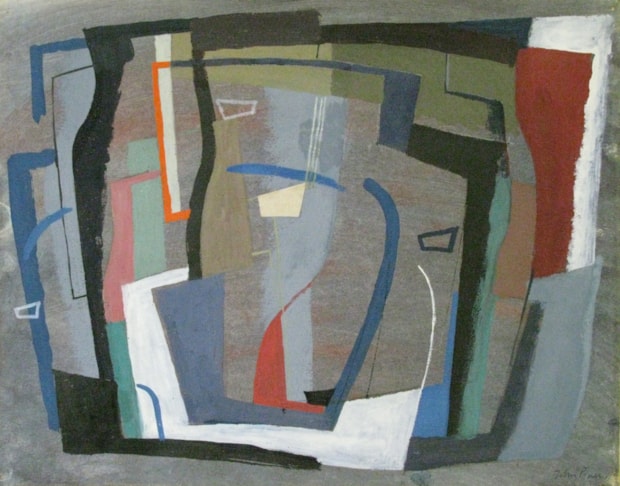
John Piper
(1903 - 1992)
Abstract
Signed
Pencil, gouache and collage on paper
9¼ x 11½ in - 23.5 x 29.2 cm
Pencil, gouache and collage on paper
9¼ x 11½ in - 23.5 x 29.2 cm
Tel.: +44 (0)20 7839 7693
Provenance
Purchased at the 1964 exhibition, by a private collector on behalf of the Texas Commerce;
Acquired by the past owner from Texas Commerce Bank, in the early 1980s;
with MacConnal-Mason Gallery (2011);
Private collection, UK
Acquired by the past owner from Texas Commerce Bank, in the early 1980s;
with MacConnal-Mason Gallery (2011);
Private collection, UK
 Exhibition
London, Marlborough Fine Art, John Piper Exhibition, March 1964, No.26
Biography
John Piper was born in Epsom, Surrey in 1903 to parents Charles and Mary. He was drawing and painting from a young age but did not start his education at Epsom College until he was fifteen. The College had a good Art Department where Graham Sutherland had also previously excelled. Piper’s father was a solicitor and encouraged his son to follow in his footsteps rather than choose an artistic career. However, after a brief period at his father’s firm and following the failure of his law examinations, Charles Piper passed away, leaving John free to pursue his artistic calling.
Piper enrolled first at the Richmond School of Art, followed by The Royal College of Art in Kensington. Upon completion of his studies he wrote numerous articles for magazines and newspapers on the subject of art. Piper’s work was concerned with abstraction during this period and initially he found it hard to find buyers for his work. He soon befriended like minded artists Ben Nicholson, Barbara Hepworth, Henry Moore and Ivon Hitchens who, along with others, exhibited as the Seven and Five Society (later Seven and Five Abstract Group). The group held Britain’s first entirely abstract exhibition at the Zwemmer Gallery in 1935.
As time drew on Piper’s work was to become increasingly naturalistic and representational, as he distanced himself from abstraction and began rendering the historically and architecturally significant. During WWII Piper was employed as an official War Artist and used his abilities to depict many of England’s famous sites devastated by German bombing campaigns, such as Westminster Abbey and Coventry Cathedral. After the war he designed the new Stain Glass windows for the Cathedral that he had seen destroyed, and later made tapestries for both Chichester and Hereford Cathedral.
Piper continued recording his deep romantic vision of the topographical for the remainder of his life; he collaborated on a number of projects, from set designs for Glyndebourne and the Royal Opera House to illustrations accompanying Travel Guides and volumes of Poetry. Piper also continued to write extensively for books and columns on modern art.
He died at home where he had lived happily for much of his life, in Fawley Bottom Farmhouse, Oxfordshire.
His works can be found in public and private collections including: London, Tate Gallery; London, Imperial War Museum; Eastbourne, Towner Gallery; Chichester, Pallant House; Reading Museum;
The Royal Collection; The Gyselynck Collection
