


George Peter Lanyon
(1918 - 1964)
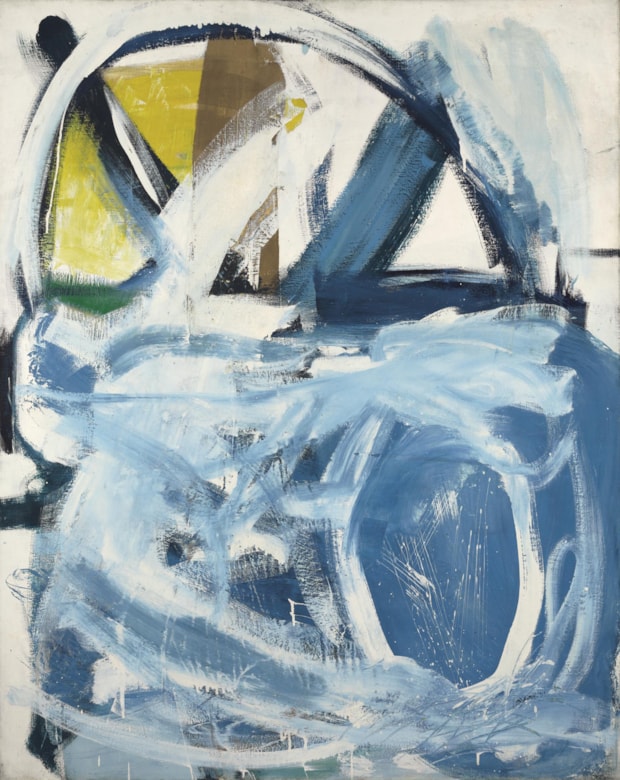
Sea Going
Signed and dated; signed and dated again, and inscribed on the reverse
Oil on canvas
60 x 48 in – 152.4 x 121.9 cm
Oil on canvas
60 x 48 in – 152.4 x 121.9 cm
Tel.: +44 (0)20 7839 7693
Provenance
with Gimpel Fils, London;
Private collection, USA;
Private collection;
with Macconnal-Mason Gallery (2013);
Private collection, UK
Private collection, USA;
Private collection;
with Macconnal-Mason Gallery (2013);
Private collection, UK
 Literature
A. Causey, Peter Lanyon, Oxfordshire, 1971, p.64, No.169
Exhibition
London, Gimpel Fils, Peter Lanyon, October 1962, No.4;
London, Arts Council of Great Britain, Tate Gallery, Peter Lanyon, May – June 1968, No.72:
this exhibition travelled to Plymouth, City Museum and Art Gallery, July – August;
Newcastle Upon Tyne, Laing Art Gallery, August; Birmingham, City Museum and Art Gallery,
September; and Liverpool, Walker Art Gallery, October
London, Arts Council of Great Britain, Tate Gallery, Peter Lanyon, May – June 1968, No.72:
this exhibition travelled to Plymouth, City Museum and Art Gallery, July – August;
Newcastle Upon Tyne, Laing Art Gallery, August; Birmingham, City Museum and Art Gallery,
September; and Liverpool, Walker Art Gallery, October
Biography
Peter Lanyon was born on 18th February 1918 in St. Ives, Cornwall. In 1936 he received tuition from Borlase Smart, a local landscape painter, and in 1937 studied at the Penzance School of Art. In the same year he met Adrian Stokes, who advised him to go to the Euston Road School, which he attended for a few months. In 1939 he met Ben Nicholson (1894-1892), Barbara Hepworth (1903-1975) and Naum Gabo (1890-1977), who had moved to St. Ives on the outbreak of war. Lanyon was immediately influenced by them and the character of his work changed completely. He stopped painting landscape studies and began to make constructions, many of which were intended as preparatory ideas for paintings. From 1940 to 1945 he served in the Royal Air Force.
Throughout the 1940s the influence of Gabo and Nicholson was paramount. Lanyon made linear free-standing sculptures and ‘built’ his paintings as if from a three-dimensional model. His paintings became progressively freer and he evolved a kind of lyrical abstraction based on landscape. He wanted to find a fresh way of organising the space in a composition, in order that a landscape could be viewed from all angles – above, below, and from the sides – as if the spectator were walking about in the picture space. The breakthrough paintings were “St. Just”, 1953, and “Porthleven”, 1951 (Tate Gallery); the latter was commissioned by the Arts Council for the Festival of Britain exhibition. Both these paintings, although primarily landscapes, have figurative connotations: Lanyon saw “St Just” as also a crucifixion, and two residual standing figures can be discerned in “Porthleven” (which was developed with the help of constructions).
Lanyon was aware, earlier than his compatriots, of American Abstract Expressionism. He was included in a mixed exhibition in New York in 1951 and in 1957 had a one-man show there; his work was well received and he felt himself to be more successful in New York than in London. He made friends with American painters – Kline (1910-1962), Motherwell (1915-1991) and Gottlieb (1903-1974) – and in particular with Rothko (1903-1970), for whom he tried unsuccessfully to find a studio in St. Ives.
In 1959 he took up gliding, primarily as a way of getting to know the landscape better. He said: “The pictures now combine the elements of land, sea and sky – earth, air and water”. Into these gliding paintings he began to introduce more colour, which he laid in flat planes; the handling became broader and the areas of paint were more clearly defined. He died following a gliding accident on 31 August 1964.
During the last years of his life, Lanyon travelled frequently abroad, having found the art world in Britain too provincial, although his own art was rooted firmly in the landscape of his native Cornwall. He exhibited during his lifetime at the Lefevre Gallery and at Gimpel Fils in London, at Catherine Viviano, New York, and in the 1961 São Paulo Bienal. In 1968 he had a posthumous retrospective at the Tate Gallery and in 1978 at the Whitworth Art Gallery, Manchester. Ten paintings were included in the catalogued ‘St. Ives’ exhibition at the Tate Gallery in 1998.
