


Patrick Heron
(1920 - 1999)
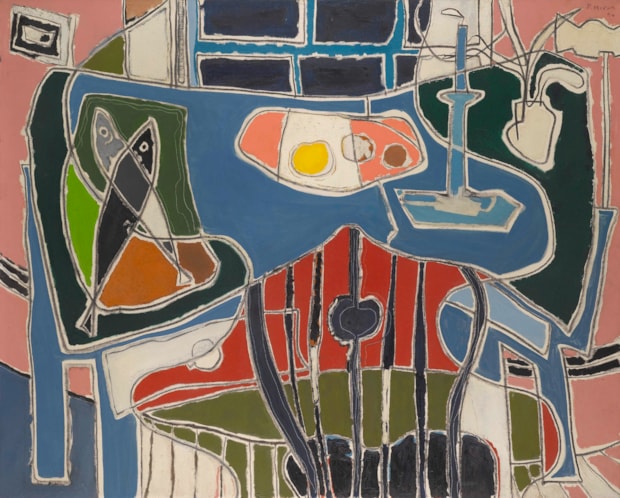
The Blue Table with Window, 1954
Signed and dated 54
Oil on canvas
40 x 50 in - 102 x 127 cm
Oil on canvas
40 x 50 in - 102 x 127 cm
Tel.: +44 (0)20 7839 7693
Provenance
The Redfern Gallery, London, where acquired by Wilfred A. Evill, July 1954 for £175.0.0 by whom bequeathed to Honor Frost in 1963;
with MacConnal-Mason Gallery (2011);
Private collection, UK
with MacConnal-Mason Gallery (2011);
Private collection, UK
 Exhibition
London, The Redfern Gallery, Patrick Heron New Paintings 12 May – 5 June 1954, Cat. No. 4;
Hampstead, The Home of Wilfrid A. Evill, Contemporary Art Society, Catalogue of the Greater Portion of a Collection of Modern English Paintings, Water Colours, Drawings and Sculpture Belonging to W. A. Evill, March 1955, Cat. No. 114 (as Still Life);
London, The Home of Wilfrid A. Evill, Contemporary Art Society, Pictures, Drawings, Water Colours and Sculpture, April – May 1961, (part IV – section 4) Cat. No.13;
Brighton, Brighton Art Gallery, The Wilfrid Evill Memorial Exhibition, June – August 1965, Cat. No.54
Hampstead, The Home of Wilfrid A. Evill, Contemporary Art Society, Catalogue of the Greater Portion of a Collection of Modern English Paintings, Water Colours, Drawings and Sculpture Belonging to W. A. Evill, March 1955, Cat. No. 114 (as Still Life);
London, The Home of Wilfrid A. Evill, Contemporary Art Society, Pictures, Drawings, Water Colours and Sculpture, April – May 1961, (part IV – section 4) Cat. No.13;
Brighton, Brighton Art Gallery, The Wilfrid Evill Memorial Exhibition, June – August 1965, Cat. No.54
Biography
Patrick Heron was born in Headingley, Leeds on 30th January 1920. His father worked in textiles and in 1925 the family moved to Cornwall where he managed a silk works in St. Ives. In 1930 the family moved once again to Hertfordshire where Patrick Heron’s father founded Cresta Silk for whom Heron was to produce designs in the 1930s up until 1951. Heron continued his education at St. George’s School Harpenden following which he studied at the Slade School of Art 1937-39 under Randolph Schwabe (1885-1948) professor there from 1930.
During the war years, when Heron was a conscientious objector he worked on the land in Cornwall and in 1944-45 in the workshop of the potter Bernard Leach. Here he met the luminaries of the St. Ives School, Ben Nicholson and Barbara Hepworth. The end of the war saw Heron living in London. The Braque exhibition at the Tate of 1946 was to prove a significant influence on his painting and in 1947 he held his first one-man show at the Redfern Gallery. A critic and writer on art, Heron wrote for the New Statesman 1947-50 and was London correspondent for “Arts” a New York magazine, 1955-58, he also published works on Hitchens and Braque in 1955 and 1956 respectively.
In 1952 a retrospective exhibition of Heron’s works was shown at Wakefield Art Gallery and in 1953-4 twelve paintings were shown at the Biennale in Sao Paulo Brazil. Heron organised an exhibition of contemporary art at the Hanover Gallery, London in 1953 and taught at Central School of Art 1953-56.
The mid 1950s were to prove particularly significant with Heron’s appreciation of American Abstract Expressionism and his move to Zennor in Cornwall in 1956. These two factors were instrumental in forming Heron’s subject and style for the future.
In 1960 Heron held his first one-man show in New York at the Bertha Schafer Gallery and his reputation and stature progressively grew. He had won the John Moores prize of 1959 in Liverpool and in 1965 was awarded a silver medal in Sao Paulo. Retrospectives were held at the Whitechapel Art Gallery in 1972 and at the Barbican London in 1985.
Heron was undoubtedly one of the leading British artists of the second half of the 20th century, a teacher and writer on art who was to prove widely influential. He died in Zennor, Cornwall on 30th March 1999.
His works can be seen in museums in: London; Edinburgh; Warwick; Liverpool; Newcastle; Sydney, Australia; Indiana, Missoula and Norman, USA.
