Edward John Gregory
(1850 - 1909)
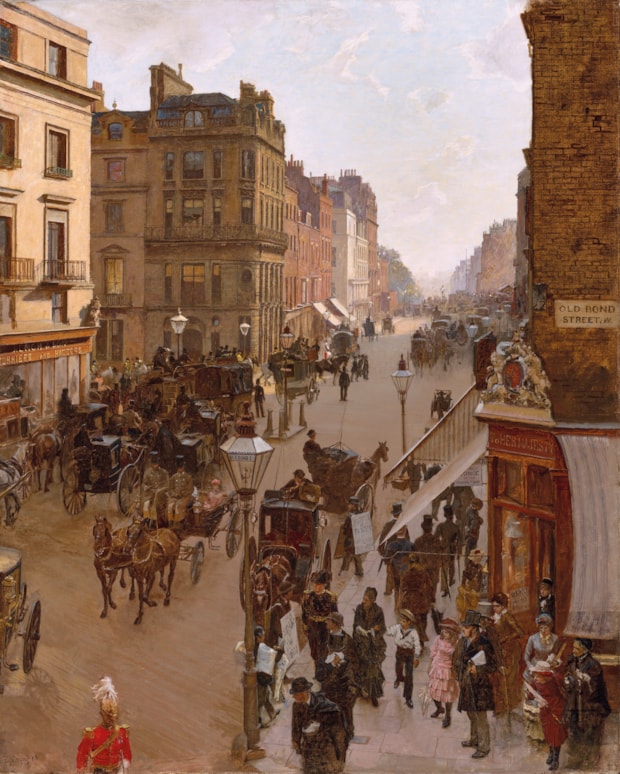
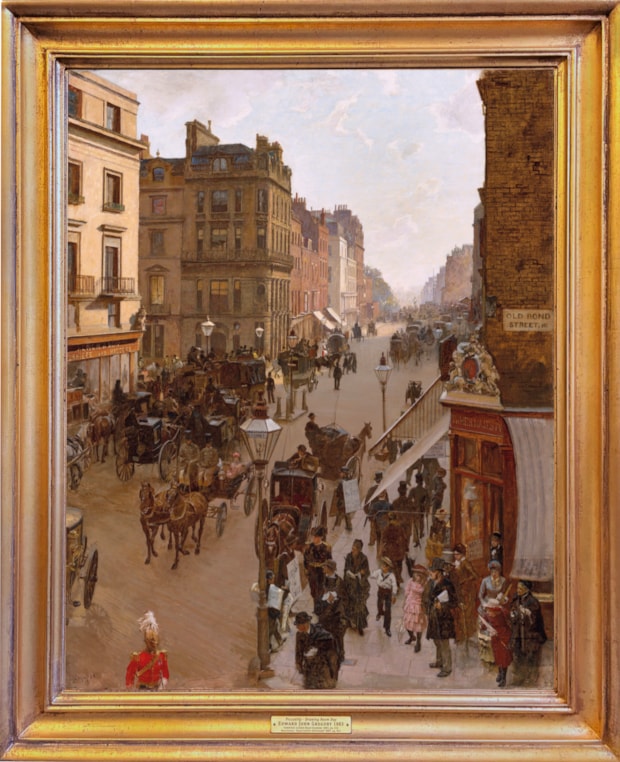
Piccadilly – Drawing Room Day
Signed and dated, lower left: E. J. Gregory 83; inscribed on a fragmentary label, on the reverse:
Piccadilly – Drawing room/E. J Gregory, A.R.A./Abercorn place/Maida Vale
Oil on canvas
31 x 25¼ in – 79 x 64.5 cm
Frame size
37 ⅜ x 31 ⅛ in – 94.9 x 79 cm
Piccadilly – Drawing room/E. J Gregory, A.R.A./Abercorn place/Maida Vale
Oil on canvas
31 x 25¼ in – 79 x 64.5 cm
Frame size
37 ⅜ x 31 ⅛ in – 94.9 x 79 cm
Tel.: +44 (0)20 7839 7693
Provenance
with Agnews & Sons, London;
Humphrey Roberts Esq., 8 Green Gate Place, by 1857;
Anonymous sale, Phillips, 15 December 1975, lot 128;
with Richard Green, London;
with MacConnal-Mason Gallery, London,
Private collection, UK
Humphrey Roberts Esq., 8 Green Gate Place, by 1857;
Anonymous sale, Phillips, 15 December 1975, lot 128;
with Richard Green, London;
with MacConnal-Mason Gallery, London,
Private collection, UK
 Literature
A. L. Baldry, “The Art of Edward John Gregory in The Studio”, 1909, vol.48, no.199, p.87
Exhibition
London, Royal Academy, 1883, no.112;
Manchester, “Royal Jubilee Exhibition”, 1887, no.921, as “Drawing Room Day in Piccadilly”, lent by Humphrey Roberts
Manchester, “Royal Jubilee Exhibition”, 1887, no.921, as “Drawing Room Day in Piccadilly”, lent by Humphrey Roberts


Biography
Edward John Gregory was one of the most accomplished British painters of the late nineteenth century, celebrated for his elegant genre scenes and portraits that capture the refinement and social life of his time.
Born in Southampton, the son of a ship’s engineer, Gregory showed early artistic talent. He started his training in the drawing office of the P&O Steamship Company in his hometown before moving to London to study at the South Kensington Art School, and, briefly, at the Royal Academy Schools. During the 1870s he travelled to Antwerp and Paris, absorbing the continental academic training and sophisticated colour harmonies of contemporary French painting. These influences helped shape the polished finish, balanced compositions and subtle tonal control that became hallmarks of his mature style.
Gregory began exhibiting at the Royal Academy in 1877 and continued to show there throughout his career. His most famous painting “Boulter’s Lock : Sunday Afternoon”, a lively boating scene, brought him widespread recognition and led to his election as a Royal Academician in 1898. Although often associated with painting interior scenes, he was equally adept at capturing outdoor subjects, including lively street scenes and leisure activities. Across all his compositions he paid close attention to costume, texture, and light, creating pictures that suggest narrative through observation and mood rather than overt drama.
Beyond the Royal Academy, Gregory exhibited at the New Gallery, Royal Society of British Artists and the Royal Institute of Oil Painters. He also served as president of the Royal Birmingham Society of Artists in 1909, an acknowledgment of his professional standing and influence. He received numerous honours in his lifetime, including a gold medal at the Paris Exposition Universelle, and his paintings were widely collected in Europe and the United States.
Gregory died in Great Marlow on 22 June 1909. His paintings remain representative of late Victorian academic art, valued for their technical assurance and their atmospheric evocation of life at the close of the nineteenth century.
His works can be seen in museums in Aberdeen; Bournemouth; Canterbury; Cornwall; London, National Portrait Gallery, Royal Academy of Arts, Victoria & Albert Museum; Merseyside; Oxford; Scotland and Delaware, USA
Born in Southampton, the son of a ship’s engineer, Gregory showed early artistic talent. He started his training in the drawing office of the P&O Steamship Company in his hometown before moving to London to study at the South Kensington Art School, and, briefly, at the Royal Academy Schools. During the 1870s he travelled to Antwerp and Paris, absorbing the continental academic training and sophisticated colour harmonies of contemporary French painting. These influences helped shape the polished finish, balanced compositions and subtle tonal control that became hallmarks of his mature style.
Gregory began exhibiting at the Royal Academy in 1877 and continued to show there throughout his career. His most famous painting “Boulter’s Lock : Sunday Afternoon”, a lively boating scene, brought him widespread recognition and led to his election as a Royal Academician in 1898. Although often associated with painting interior scenes, he was equally adept at capturing outdoor subjects, including lively street scenes and leisure activities. Across all his compositions he paid close attention to costume, texture, and light, creating pictures that suggest narrative through observation and mood rather than overt drama.
Beyond the Royal Academy, Gregory exhibited at the New Gallery, Royal Society of British Artists and the Royal Institute of Oil Painters. He also served as president of the Royal Birmingham Society of Artists in 1909, an acknowledgment of his professional standing and influence. He received numerous honours in his lifetime, including a gold medal at the Paris Exposition Universelle, and his paintings were widely collected in Europe and the United States.
Gregory died in Great Marlow on 22 June 1909. His paintings remain representative of late Victorian academic art, valued for their technical assurance and their atmospheric evocation of life at the close of the nineteenth century.
His works can be seen in museums in Aberdeen; Bournemouth; Canterbury; Cornwall; London, National Portrait Gallery, Royal Academy of Arts, Victoria & Albert Museum; Merseyside; Oxford; Scotland and Delaware, USA

YOU MAY ALSO LIKE