back@using System.Web;



John Hoyland, RA
(1934 - 2011)
John Hoyland was a leading figure in the development of abstract painting in Britain in the second half of the 20th century, acclaimed for works that explore the relationship between colour and form. Born in Sheffield, he studied at Sheffield College of Art from 1951 to 1956, before continuing his training at the Royal Academy Schools until 1960.
Hoyland travelled widely, including a formative visit to the United States in 1964, where he met key figures in American abstraction such as Robert Motherwell (1915-1991) - who became a lifelong friend - as well as Mark Rothko (1903-1970) and Barnett Newman (1905-1970). He visited their studios and engaged directly with their work, which had a lasting impact on his practice.
From 1960 onwards, he exhibited regularly in London with galleries including Marlborough and Waddington, and his reputation was further established after being awarded the John Moores Painting Prize in 1967. Major exhibitions of his work were held at Whitechapel Gallery in 1967 and 1982, followed by a full retrospective at the Royal Academy in 1994. He was elected
a Royal Academician in 1991 and appointed Professor of Painting at the Royal Academy Schools in 1999.
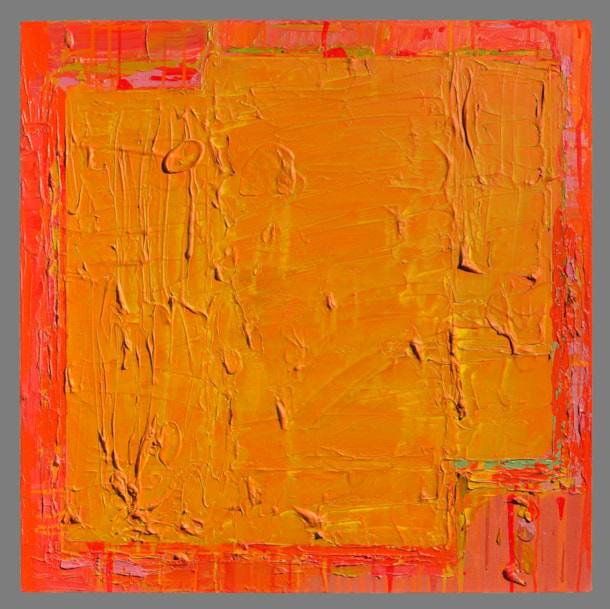
His work is characterised by a vivid use of colour and various methods of applying paint - brushed, applied with a palette knife, poured, and splattered. Over time, his style evolved from minimal compositions with clearly defined structures to a more expressive and spontaneous approach in his later career.
Hoyland’s work is held in numerous major public collections, including Cambridge, The Fitzwilliam Museum; Leeds Art Gallery; London, Tate; the Government Art Collection; Manchester Art Gallery and Connecticut, Yale Center for British Art.