back@using System.Web;



Alfred Boucher
(1850 - 1934)
Alfred Boucher was born on 23rd September 1850 at Bouy-sur-Orven, close to Nogent sur Seine. In 1859 his parents found positions working for the sculptor Marius Ramus (1805-1888), and it was from this renowned sculptor that Alfred Boucher received his early tuition. Boucher’s earliest work was on the decorations for the Theatre in Nogent sur Seine following which, with the assistance of Ramus and the commune of Nogent sur Seine, Boucher enrolled at the Academy des Beaux-Arts in Paris in 1869. Here Boucher studied with the sculptors Paul Dubois (1829-1905) and Auguste Alexandre Dumont (1801-1884), Professor at the Academy. Nogent sur Seine, a small village was home to four generations of sculptors, amongst the finest of their age, Marius Ramus (1805-1888), Paul Dubois (1829-1905), and Boucher himself, Camille Claudel (1864-1943).
Boucher first exhibited at the Salon in 1874 “Child at a Fountain” and a portrait bust, for which he received a third-class medal. A sculptor with a rapidly growing reputation he failed to win the coveted ‘Prix de Rome’ in 1876 and 1877 being placed second on each occasion. He travelled to Italy, however, in 1877-78 and subsequently in 1883-84. In 1878 following his second-class medal at the Salon for “Eve after the Fall” Boucher received the first of what were to be numerous state commissions. In 1881 he received the Prix de Salon, in 1886 a first-class medal, in 1891 the Medal of Honour and in 1900 the Grand Prix at the World Fair. Boucher had been elected Chevalier, Legion d’Honneur and was appointed an officer in 1925.
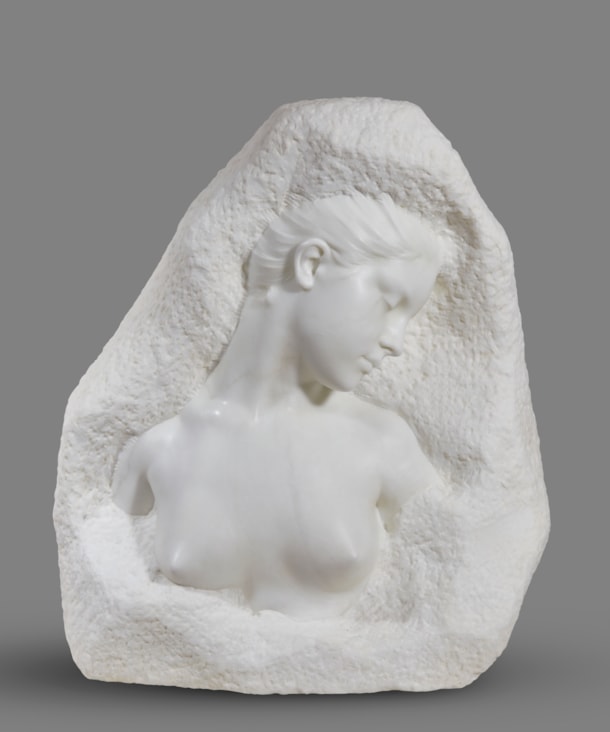
Boucher was a sculptor in stone, marble, bronze and plaster renowned for his decorative naturalistic works; his portrayals of the female nude exhibit a sensitivity tinged with eroticism as seen in works such as “Volubilis” (exhibited Salon 1896) or “Eve after the Fall” (exhibited Salon 1878). These evocations of female beauty in marble are frequently sculpted in bas relief, the highly finished polished patina contrasting with the rough-hewn marble, a technique he shared with his friend August Rodin (1840-1917). The patina Boucher achieves in his marble sculptures owes much to the years that he studied in Italy, where the works of Antonio Canova (1757-1822) must have been a source of inspiration. Boucher himself set up a workshop in Paris in 1902 to assist impoverished sculptors and worked both there and in Aix le Bain where he had a studio from 1889. Boucher had a number of pupils including Camille Claudel (1864-1943), who he passed on to August Rodin, his close friend and rival.
Boucher continued to work following the Great War 1914-1918 turning to alternative materials including concrete and iron for war memorials in Nogent sur Seine 1920, and Aix le Bain 1922.
His works can be found in museums in: Le Puy; Montpellier; Paris; Strasbourg and Troyes.
Boucher first exhibited at the Salon in 1874 “Child at a Fountain” and a portrait bust, for which he received a third-class medal. A sculptor with a rapidly growing reputation he failed to win the coveted ‘Prix de Rome’ in 1876 and 1877 being placed second on each occasion. He travelled to Italy, however, in 1877-78 and subsequently in 1883-84. In 1878 following his second-class medal at the Salon for “Eve after the Fall” Boucher received the first of what were to be numerous state commissions. In 1881 he received the Prix de Salon, in 1886 a first-class medal, in 1891 the Medal of Honour and in 1900 the Grand Prix at the World Fair. Boucher had been elected Chevalier, Legion d’Honneur and was appointed an officer in 1925.
Boucher was a sculptor in stone, marble, bronze and plaster renowned for his decorative naturalistic works; his portrayals of the female nude exhibit a sensitivity tinged with eroticism as seen in works such as “Volubilis” (exhibited Salon 1896) or “Eve after the Fall” (exhibited Salon 1878). These evocations of female beauty in marble are frequently sculpted in bas relief, the highly finished polished patina contrasting with the rough-hewn marble, a technique he shared with his friend August Rodin (1840-1917). The patina Boucher achieves in his marble sculptures owes much to the years that he studied in Italy, where the works of Antonio Canova (1757-1822) must have been a source of inspiration. Boucher himself set up a workshop in Paris in 1902 to assist impoverished sculptors and worked both there and in Aix le Bain where he had a studio from 1889. Boucher had a number of pupils including Camille Claudel (1864-1943), who he passed on to August Rodin, his close friend and rival.
Boucher continued to work following the Great War 1914-1918 turning to alternative materials including concrete and iron for war memorials in Nogent sur Seine 1920, and Aix le Bain 1922.
His works can be found in museums in: Le Puy; Montpellier; Paris; Strasbourg and Troyes.